Petra
🇯🇴 Jordan
Travel tips for Petra
7 tips from 7 contributors
Everyone shuffles down the Siq to the Treasury then either turns around or keeps going to the Monastery. Meanwhile, Wadi Farasa Trail is sitting there with some of the best carved facades in Petra and you'll have them basically to yourself.
What you'll see: Garden Temple complex, Roman Soldier Tomb (with its detailed Nabataean carving that rivals the Treasury), Renaissance Tomb, and my absolute favourite — The Lion Monument fountain with an actual functioning 2,000-year-old water system still trickling into a basin. The engineering is mind-blowing when you realize this thing has been working since before Jesus was born.
Trail details: 2.5-3 hours total if you're taking your time with photo stops. Moderate difficulty — Some scrambling over smooth limestone but nothing technical. Trail starts past the Roman Theatre (about 900m from Treasury), veers left where most people go right toward the Monastery path. Look for the small brown sign that says "Wadi Farasa" — Easy to miss if you're following the crowd.
Gear notes: Proper hiking shoes are non-negotiable. The smooth rock gets dangerously slippery, especially if there's been any moisture. Bring 2+ liters of water per person — There's nowhere to refill until you're back near the main path or you reach Wadi Farasa Restaurant at the trail end (where you can grab sweet mint tea for 2 JOD).
Timing tip: Go mid-to-late afternoon. I did this around 3pm in April and passed maybe 6 other people the entire time. The warm light between 4-5pm hits these rose-red facades perfectly — Way better than the harsh overhead sun that washes out the Treasury photos. You'll actually see why they call it the "Rose City" when that golden hour light hits.
 coastalhike
Guides at Petra entrance will quote you 50-70 JOD for a basic tour. This is negotiable, especially if it's afternoon or you're visiting in low season (November-February). I paid 40 JOD for 2.5 hours with a guide who showed me routes I never would have found on my own.
What to agree on before starting: Duration, which sites you want to see (Treasury, Monastery, High Place of Sacrifice, etc.), whether the price includes just route guidance or also historical explanation, and whether they expect baksheesh (tip) on top of the agreed price. Be direct about this. A good guide will appreciate the clarity and respect your straightforwardness — It's far better than awkward conversations at the end.
The real value: It's not just the history (though hearing about Nabataean trade routes and water systems is fascinating). It's knowing which paths avoid crowds and where to stop for the best views. My guide took me up a scramble trail to see the Treasury from above — Not marked on any map, involves climbing through a narrow canyon for about 20 minutes, but the aerial perspective is absolutely worth it. He also knew exactly when the tour groups would flood certain areas, so we timed our route to stay ahead of them.
Negotiation strategy: Don't hire the first person who approaches you outside. Walk into the site, get oriented, see the Treasury, then decide if you want a guide for the rest. You can hire guides inside the site near the Basin Restaurant area too, and you'll have better negotiating position once you're already there. In my experience, guides are more flexible on price around 2-3pm when the morning rush is over.
The guides waiting at the entrance are all licensed and knowledgeable — You're not risking quality by negotiating, you're just getting a fair price.
 nadia_m
Everyone stresses about getting there at opening to beat the heat but honestly the afternoon is when it actually gets good. The cruise ship tours and amman day-trippers leave around 2pm and suddenly you have space to breathe. Plus the light gets warmer and less harsh for photos.
I showed up at 1pm, walked through when it was hot yeah, but by 3pm the temperature dropped noticeably and the treasury had like 15 people instead of 200. Wandered around until closing at 6pm and had entire sections basically empty. The monastery at 5pm? Maybe 8 people there. Actually got to sit on the steps and take it in without someone's ipad in my face.
Brought 3 liters of water and was completely fine. Wore a hat. Didnt die. The bedouin tea guys are still open late afternoon so you can take breaks in the shade if needed.
Morning people can have their sunrise. Ill take an empty monastery and that insane pink-orange glow on the treasury facade at 5:30pm thanks. Like the stone literally looks like its glowing from within when the sun gets low. Morning light is cool-toned and washes it out by comparison.
Caveat: this works october through april. If youre going in summer you probably do want those morning hours because even 3pm is gonna be brutal. But shoulder season and winter? Afternoon gang wins.
Also you can sleep until like 10am, have a proper breakfast, show up refreshed instead of zombie-walking through the siq at 6am having woken up in the dark. Just saying.
The honest truth: The main Siq pathway to the Treasury is theoretically wheelchair accessible — It's relatively flat and paved in sections. But the reality is more complicated, and I want to give you the real picture so you can make informed decisions.
What is genuinely accessible: The first 1.2km through the Siq canyon to the Treasury. That's it. The path is mostly compacted dirt and stone with some paved sections, but there are uneven cobblestones, sandy patches where wheels sink, and areas where the path narrows to about 1.5 meters with camels and horses sharing the space. I made it to the Treasury in my manual chair but it was exhausting and I needed someone to help push over rough sections. If you use a power chair, the sand and uneven stone will be challenging for your battery and motors.
What is NOT accessible: Everything beyond the Treasury requires stairs, steep inclines, or rocky terrain. The Monastery? 800+ uneven rock-cut steps. The High Place of Sacrifice? Steep climbing trail. Wadi Farasa? Scrambling over boulders. The Royal Tombs area has some parts you can see from a distance, but getting close means steps.
Services available: Horse-drawn carriages can take you through the Siq to the Treasury. They'll quote 20-25 JOD but negotiate firmly — I got mine for 12 JOD. Some carriages have a small step platform making transfers easier; others require climbing up which isn't feasible for many wheelchair users. Ask to see the carriage before agreeing. The drivers are generally helpful with transfers if you communicate what you need.
My recommendation: If you have limited mobility but can do some walking with breaks, you'll enjoy the Treasury area and the Street of Facades. If you use a wheelchair full-time, know your limits and don't let anyone pressure you into thinking you can access the whole site. You can't, and that's okay — The Treasury itself is magnificent and seeing it is absolutely worth the trip to Jordan. Just set realistic expectations and you'll have a great experience rather than a frustrating one.
 wheelsfirst
Seriously the only sit-down restaurant inside petra (basin restaurant, its that big buffet place in the middle of the site) charges 15 jod for a pathetic buffet with cold food and flies everywhere trust me you do not want this. Its designed to trap exhausted tourists who didnt plan ahead and have no other options.
Heres what to do instead: bring your own snacks and water from wadi musa town where a bottle costs 0.50-1 jod not 3 jod inside the site. Theres a good supermarket called cozmo express on tourism street in wadi musa where you can stock up on water, fruit, nuts, chocolate bars, whatever you need. Load up your daypack before entering petra.
The bedouin tea stalls inside petra are fine for a break and theyre only 1-2 jod for sweet mint tea or sage tea. Honestly the tea is good and the guys running them are usually nice and will let you sit in the shade. Theres one near the royal tombs and another near the monastery that both have decent views. Just tea and rest, nothing more.
If youre staying multiple days in wadi musa theres a spot called al wadi restaurant on main tourist street (al-wadi al-mousa street, near the movenpick) that does proper mansaf and maqluba for 7-9 jod. The lamb mansaf there is genuinely good, comes with the whole yogurt sauce situation and rice and almonds. Way better than any tourist buffet.
Also al qantarah restaurant does excellent falafel sandwiches for 2 jod if youre on a budget. Get like three of them, stuff them in your bag, boom you have lunch at petra.
Just whatever you do dont get suckered into basin restaurant honestly save your money for literally anything else. Even overpriced water inside petra is a better deal than that buffet.
Entrance ticket: 50 JOD for one day (90 JOD for multi-day but only worth it if youre doing 3+ days honestly)
Water inside: 3 JOD per bottle (robbery). Buy in wadi musa for 0.5-1 JOD
Tea at bedouin stalls: 1-2 JOD
Horse through the siq: they say 20 JOD, negotiate to 10-12 JOD
Donkey to monastery: 10-15 JOD one way, 20 JOD return (walked it myself, saved the money)
Guide services: 35-50 JOD for 2-3 hours depending on negotiation skills
Basin restaurant buffet: 15 JOD (skip it, see other posts)
Total damage if you bring your own food and walk everything: just the 50 JOD entrance plus maybe 5 JOD for tea and emergency water. Did the whole site for 55 JOD which felt reasonable for a world wonder.
 cheapcharlie
Everyone tries to cram Petra into one exhausting day and misses half of what makes it special. The two-day pass (90 JOD vs 50 JOD for single day) lets you actually explore at a reasonable pace.
Day 1 strategy: Arrive at opening, walk through the Siq to the Treasury while it's still relatively empty. Continue to the Monastery via the main path (those 800 steps take time). Spend late afternoon exploring the Royal Tombs area. You'll cover the major sites without feeling rushed.
Day 2 strategy: This is when you do the alternative trails like Wadi Farasa or the High Place of Sacrifice. These take 2-3 hours each and you simply don't have time on a one-day visit. I also went back to the Treasury at sunset on day 2 and had it nearly empty — Completely different experience from the morning chaos.
Comparison: Having done one-day visits at Angkor Wat and Machu Picchu, Petra is genuinely bigger and more spread out than people realize. The single-day rush mentality means most visitors see 30% of the site. Two days gets you to about 70%, which feels much more satisfying.
Stay in Wadi Musa between days — Accommodation is cheap and you're 5 minutes from the entrance.
 passportpages
About Petra
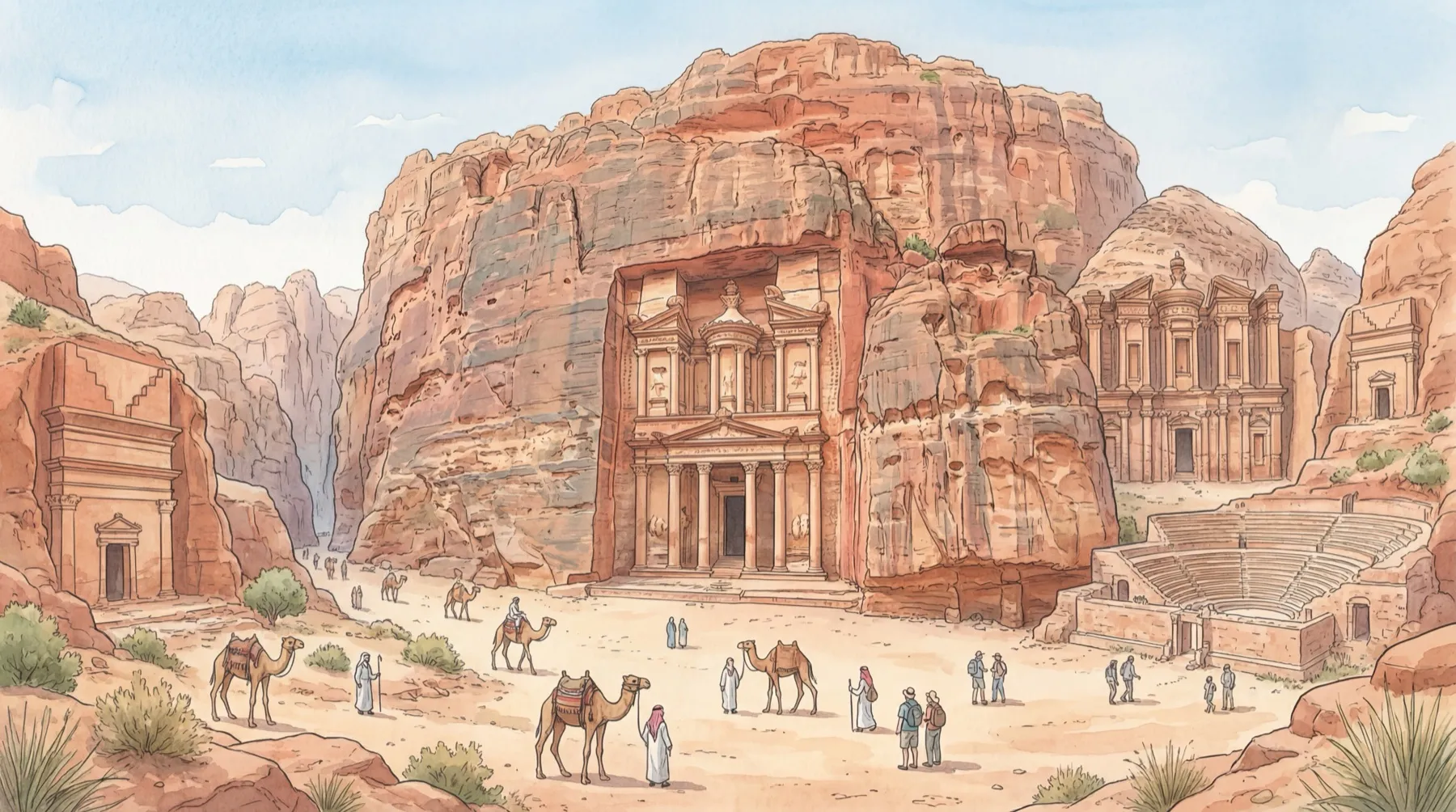
Ancient Jordanian city carved into rose-red sandstone cliffs, lost to the Western world until 1812. The Treasury and Monastery represent Nabataean engineering and architectural mastery.
Destination Stats
Know something locals know? Share your insider tip.
+ Share a Tip