Dublin
🇮🇪 Ireland
Things to see Tips for Dublin
Must-visit landmarks, hidden gems, and sightseeing
Book of Kells at Trinity College (famous medieval manuscript) — skip the queues with advance tickets
Trinity College's Book of Kells exhibition consistently sells out weeks in advance, and the walk-up queues are genuinely brutal. I waited 90 minutes in August and watched dozens of disappointed tourists get turned away at closing time. Book your tickets online at Trinity College's official website at least 7-10 days ahead, especially for summer visits when demand peaks.
The Long Room Library is the true highlight — A breathtaking 65-metre medieval hall housing 200,000 ancient books, including first editions of works by Shakespeare and Jonathan Swift. The actual Book of Kells manuscript pages are exquisite, but you'll only get 30-60 seconds to view them before being ushered along by staff. The interactive exhibition beforehand provides essential context about medieval Irish monasticism and illuminated manuscripts.
Entry costs €18-25 depending on season (peak summer pricing applies June-August). The fast-track option costs an additional €5 but is genuinely worth every penny when standard tickets are sold out. Arrive for the 10 AM opening to experience the Long Room in relative tranquillity — By noon, it's shoulder-to-shoulder tourists. Take the Luas Green Line to Trinity stop (2-minute walk) or bus routes 7, 25X, or 66 to Nassau Street.
Pro tip: The library shop sells high-quality reproductions of the manuscript pages — Perfect for appreciating the intricate Celtic knotwork designs you couldn't study properly during the brief viewing time.
Kilmainham Gaol stands as Ireland's most significant historical prison, where the leaders of the 1916 Easter Rising were executed and countless Irish revolutionaries were held during centuries of British rule. The guided tours are profoundly moving and deliberately limited to intimate groups of 25-30 people, which explains why tickets disappear within hours of release.
Set an alarm for exactly midnight Irish time, 28 days before your intended visit date. The booking system at kilmainhamgaolmuseum.ie opens precisely at midnight, and weekend slots (especially Saturday afternoons) sell out within 2-3 hours. I learned this timing the hard way after checking daily for a week, watching availability remain at zero. Weekday morning slots typically last until 6-7 AM.
The 90-minute guided tour encompasses the Victorian east wing, the 1916 corridor where the Rising leaders spent their final days, and the chilling execution yard where 14 men were shot by firing squad. Your guide will share excerpts from the prisoners' final letters to their families — Genuinely heart-wrenching moments that illuminate Ireland's struggle for independence. The restored chapel where Grace O'Malley's wedding took place adds another layer of historical significance.
Entry costs €9 for adults, free for EU students with valid student cards. The museum is located on Inchicore Road, easily reached by Dublin Bus routes 13, 40, or 69 from the city centre. Like the best historical literature, this experience stays with you long after the tour ends — Essential reading for understanding modern Ireland's complex relationship with its revolutionary past.
While tourists queue 90 minutes for the Gravity Bar's overpriced pint-with-a-view, this 200-step climb up an 1895 distillery chimney offers equally spectacular panoramas with zero crowds. €3 admission to ascend the exterior spiral staircase — Proper wind-in-your-hair viewing platform at 185 feet.
The surrounding Smithfield Square itself rewards slow exploration: original cobblestones, cast-iron market halls, and that perfect juxtaposition of weathered brick against modern glass that makes for compelling compositions. Take the Red Luas line to Smithfield stop — The tower is literally 30 seconds' walk north of the platform.
Golden hour timing is crucial here. Late afternoon light (around 4-5pm) illuminates the Liffey's curve while casting long shadows across the medieval street grid. From the top, you can trace Dublin's layers: Georgian terraces, Victorian industrial architecture, and those jarring modern developments. The contrast creates natural leading lines perfect for wide-angle shots.
Weather moves fast at this height — I've seen brilliant sunshine turn to dramatic storm clouds within minutes, creating moody lighting that beats any Instagram filter. Bring layers and check wind conditions before climbing.
 cammie_k
While thousands pack into St Stephen's Green daily, this hidden sanctuary tucked behind the National Concert Hall on Hatch Street Upper remains blissfully undiscovered. The energy here is completely transformative — I've watched stressed tourists literally exhale tension as they walk through the unassuming entrance at Clonmel House.
The centerpiece is an unexpected cascade waterfall and grotto that feels more like tropical Bali than downtown Dublin. Free entry with seasonal hours (8am-4pm winter, 8am-7:30pm summer weekdays; 10am start weekends). The Victorian-era design includes formal lawns perfect for mindful picnicking, tree-lined walks for walking meditation, and secluded benches where you can actually hear birdsong instead of traffic.
What makes this space truly special is its intentional design for contemplation — The original 1865 layout includes sight lines that draw your eye toward tranquil focal points rather than busy intersections. Spring brings incredible cherry blossoms along the eastern wall, while autumn creates a golden canopy perfect for grounding exercises. Even Dublin locals don't know about this place — It's genuinely preserved the peaceful energy the Victorian designers intended.
Pro tip for fellow wellness travelers: the southwest corner near the rosary gets beautiful filtered morning light around 9am, perfect for journaling or gentle stretching. The contrast between this oasis and the bustling shopping streets just 200 meters away is profound.
 yogamat_
Tucked between Henry Street's chain stores and Parnell Street, Moore Street Market is the last proper working street market in Dublin city centre. No hipster food trucks or artisanal nonsense — Just old-school Dublin vendors who've been shouting prices at customers for decades. It's the real deal, and it's slowly disappearing.
Get there before noon when it's proper mental. Vendors in woolly jumpers call out "Three for a euro! Three for a euro!" while hawking everything from bruised apples to phone chargers. The banter is legendary — Thick Dublin accents throwing slagging between stalls. Cash only, obviously. Bring a shopping bag because they're not giving you one for free.
You'll find vintage bits mixed in with the veg — Old Aran sweaters, second-hand books, random household stuff that fell off the back of a truck (probably). The real finds are tucked away in the indoor section at number 8-12 Moore Street. Ask Mary at the vintage stall about her "special collection" if you're looking for proper Irish wool or old Waterford crystal.
Walking distance from O'Connell Street but a complete time warp. The developers are circling like vultures, so experience this slice of old Dublin while you still can. It's grittier than Temple Bar but infinitely more authentic.
Behind St Patrick's Cathedral, down a quiet lane most tourists never notice, stands Marsh's Library — Ireland's first public library, opened in 1701. Step inside and you're transported to another century entirely. Dark oak bookcases stretch to the ceiling, ancient volumes bound in leather and vellum, and most remarkably, three original "cages" where 18th-century scholars were literally locked in with rare manuscripts to prevent theft.
The atmosphere is extraordinary — That particular silence of old books and centuries of learning. Chains still dangle from some volumes, including Clarendon's "History of the Rebellion" and early editions of Swift's works. Archbishop Narcissus Marsh's collection remains largely intact, with 25,000 books dating from the 16th to 18th centuries. The Gothic Revival reading room, added in 1863, houses rotating exhibitions of illuminated manuscripts and incunabula.
Located at St Patrick's Close (just behind the cathedral), entry is €3 for adults. Open Monday, Wednesday-Friday 9:30am-5pm, Saturday 10am-5pm. Closed Tuesdays and Sundays. The curators are scholars themselves — Ask about seeing Gulliver's Travels annotations or the library's connection to Jonathan Swift, who was a regular visitor.
It's perhaps the most atmospheric literary space in Dublin, certainly quieter than Trinity College's Book of Kells crowds. The kind of place that reminds you why libraries were once called temples of learning.
Most tourists think Dublin has no proper beaches, but Bull Island is a 5km stretch of golden sand just 20 minutes from O'Connell Street. Connected to the mainland by a narrow wooden bridge, this UNESCO Biosphere Reserve feels like a different country — Massive open beach, rolling dunes, and proper Atlantic waves when the swell's up.
Take the DART to Clontarf Road station, then it's a 15-minute walk through residential streets to the wooden bridge, or catch Bus 130 which drops you closer to the causeway. The beach faces northeast so you get sunrise shots over Dublin Bay with the city skyline in the background — Absolute magic for early risers.
Water temp hovers around 9-15°C year-round, so pack a wetsuit if you're planning to get in. Local surfers hit the break near the wooden bridge when there's northeast wind and incoming tide. The southern end near the car park is better for families, while the northern stretch toward the lighthouse is pure wilderness — Just you, the birds, and 5km of uninterrupted sand.
Bull Island is also a major bird migration stop, so bring binoculars if you're into that scene. Best time to visit is early morning when you'll have the whole place to yourself, plus the light is epic for photos. Free parking near the bridge if you're driving, and there's a decent café at the Clontarf end for post-walk coffee.
Tucked within Dublin Castle's grounds, the Chester Beatty Library houses one of Europe's finest collections of Islamic manuscripts, Asian scrolls, and illuminated texts — All with completely free admission. While tourists queue and pay €15+ for Book of Kells crowds, you can marvel at 1,000-year-old Qurans with gold leaf illuminations and Japanese woodblock masterpieces in blessed silence.
The collection spans three floors of genuine treasures: Islamic binding techniques that influenced European bookmaking, Chinese jade books, and Burmese palm-leaf manuscripts. The Sacred Traditions gallery displays some of the world's earliest Biblical papyri alongside exquisite Quranic calligraphy. Don't miss the Japanese prints section — Woodblocks by Hokusai and Hiroshige that would command millions at auction.
Located at Dublin Castle on Dame Street, the library opens Monday, Wednesday-Friday 9:45am-5:30pm (Wednesdays until 8pm), weekends 11am-5pm. Closed Tuesdays year-round, plus Mondays from November-February. The top-floor Zen tearoom serves proper loose-leaf teas — Their jasmine green tea pairs perfectly with contemplating ancient manuscripts through floor-to-ceiling windows overlooking the castle gardens.
This collection rivals the British Museum's Asian holdings but without the crowds or entry fees. Chester Beatty was an American mining magnate who donated his life's passion to Ireland — Dublin's gain, and one of the city's most underrated cultural treasures.
 teahunter
When Temple Bar feels claustrophobic and every tourist sight is packed shoulder-to-shoulder, I escape to the National Botanic Gardens in Glasnevin. It's a 20-minute bus ride from O'Connell Street but feels like stepping into a parallel universe where crowds don't exist and your nervous system can actually reset.
The Victorian glasshouses are stunning — Humid tropical worlds with towering palms, cascading orchids, and that distinctive greenhouse smell of damp earth and growing things. The restored Curvilinear Range from the 1840s is architectural eye candy, all wrought iron and glass curves. Best part? Completely free admission, which feels miraculous in expensive Dublin. Even on sunny weekends, you'll find quiet corners to decompress.
Take Bus 13 or 19 from O'Connell Street (€2.30 with Leap Card) and get off at Botanic Road. The rose garden is my go-to spot when social anxiety kicks in — Benches tucked between climbing roses where you can sit without anyone bothering you. The alpine house is perfect for meditation, and there's usually nobody else around.
Opens 9am daily, closes 5pm in winter and 6pm in summer. Pro tip for fellow introverts: Tuesday mornings are virtually empty. Pack a book and spend a few hours recharging before diving back into Dublin's sensory overload. Your mental health will thank you.
 kiki_adventures
Don't waste €8 on the self-guided Dublin Castle tour — Empty rooms with zero context. The guided tour (€12) is marginally better but still overpriced for what you get.
Chester Beatty Library in the same grounds is free and infinitely more interesting. Skip the castle entirely unless you're completely desperate for indoor activities.
Everyone sits by the duck pond taking photos. The real peaceful spot is the meditation garden behind the bandstand. Barely anyone goes there.
Small enclosed area with benches facing inward. Perfect for morning meditation or just escaping city noise for ten minutes. The energy there is completely different from the main green.
Best early morning before office workers cut through for coffee. Even at lunch its quieter than anywhere else in the city center
Most people hit Joyce Tower in Sandycove and call it done. Dublin Writers Museum on Parnell Square covers Swift, Wilde, Shaw, Joyce, Beckett - decent starting point though displays feel dated.
Real magic following Bloomsday trail through city. Sweny's Pharmacy on Lincoln Place still sells lemon soap like Leopold Bloom bought - €2.50 bar. Evening readings, owner genuinely loves talking Joyce. Much better than reading wall plaques.
Joyce statue on North Earl Street positioned where he walked daily. Writers Museum €5, tower €8 if you're into literary pilgrimage rather than box-ticking.
If you're in dublin for more than a quick weekend, the botanic gardens in glasnevin are genuinely overlooked by tourists. Free admission, gorgeous victorian glasshouses, and usually empty except locals walking dogs
The palm house and tropical ravine are instagram-worthy but somehow not on every tourist list. Perfect quiet spot when you need a break from the city center bustle. About 20 minutes on bus from o'connell street
Tip for introverts - weekday mornings are practically deserted. You can sit in the rose garden and actually think without crowds of people asking you to take their photo
Everyone shoots ha'penny bridge midday when its packed and light is harsh. Get there 6:30am summer for proper golden hour hitting the liffey
Bridge completely empty. Reflections in calm water. You can actually compose shots without people walking through frame every two seconds
Winter sunrise later but moody grey atmosphere is incredible. Temple bar looks completely different before pubs open and crowds arrive
Poolbeg Lighthouse most photographed spot in Dublin but barely any tourists go because requires proper 45-minute walk from Sandymount DART station. Worth every step.
Follow strand at low tide for easier walking. Gets windy on breakwater so bring layers. Views back to city with Poolbeg towers (red/white striped chimneys) stunning - classic Dublin shot without crowds.
Check tide times before going. High tide makes walk much harder, potentially dangerous. Distance about 3.5km each way along beach and breakwater.
Always Free: National Gallery Ireland (Mon-Sat 9:15-17:30, Sun 11-17:30) - Caravaggio plus solid Irish collection. National Museum Archaeology (Tue-Sat 10-17, Sun-Mon 13-17) - Viking artifacts, medieval gold. Hugh Lane Gallery (check current hours) - Francis Bacon's studio reconstructed.
Irish Museum Modern Art and Science Gallery Trinity - check individual exhibition details for current access and pricing.
National museums offer free admission. Add free walking tours = full cultural day spending nothing beyond transport. Always verify hours before visiting because nothing worse than showing up to closed museums.
 spicyway
If you're set on visiting dublin castle, the self-guided version leaves most people confused. Empty rooms with wall plaques about medieval foundations and british rule.
Guided tour costs extra €8 but actually explains why place matters instead of letting you wander around lost. Guides bring the history alive. Chester beatty library same complex, free, more interesting than basic castle rooms anyway.
Honestly though, plenty better things in dublin if you're not particularly interested in castle history.
About Dublin
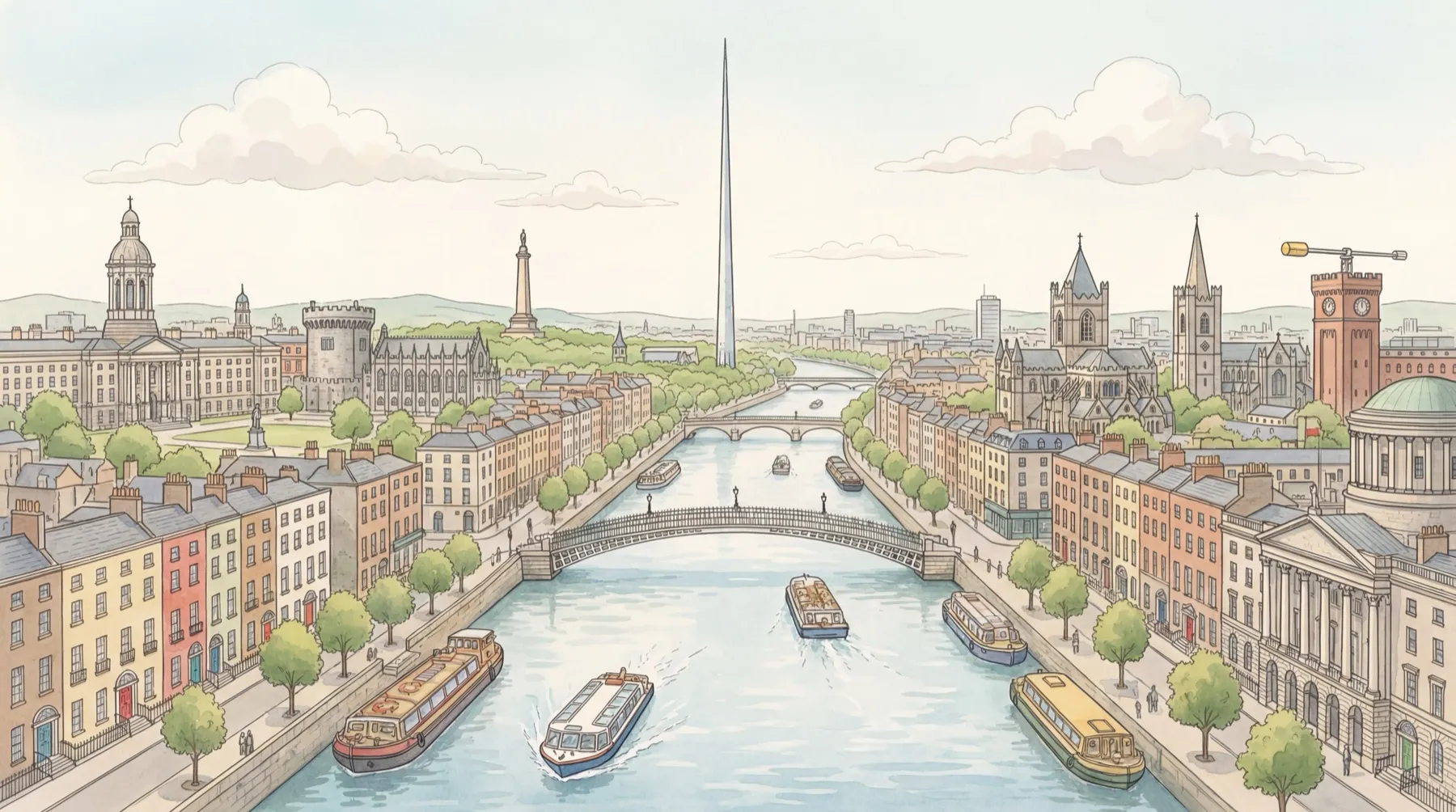
Capital of Ireland, straddling the River Liffey near the Irish Sea. Trinity College and Temple Bar district anchor this literary and cultural center.
Destination Stats
Know something locals know? Share your insider tip.
+ Share a Tip